DUB COMMANDER
Safe on a big system
What the protection stage does, why it cannot be switched off, and the habits that keep a sound system and a crowd safe.
- Level
- Beginner
- Time
- 5 min
- Steps
- 3
- Updated
- Nov 16, 2026
Written from: M3 development build (0.1.0), 2026-11-16. The interface may change before release.
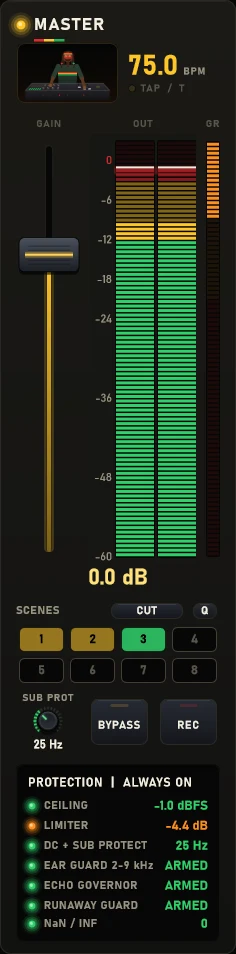
A sound system can hurt people and speakers. DUB COMMANDER has a protection stage after the master that is always on — there is no switch for it. The MASTER column shows it live (PROTECTION | ALWAYS ON):
- CEILING −1.0 dBFS — A look-ahead limiter: the output never goes above −1 dBFS, whatever you do.
- LIMITER — Shows how much it is holding back right now.
- DC + SUB PROTECT — Removes DC and sub-sonic energy below the SUB PROT knob (15–45 Hz) that only moves the cones.
- EAR GUARD 2–9 kHz — Catches squeals in the range where ears hurt most, and leaves the music alone.
- ECHO GOVERNOR — A tape-echo runaway left alone for eight seconds is pulled back.
- RUNAWAY GUARD — If the output is held at the limiter for two seconds (typically feedback), it latches PANIC and tells you why.
- NaN / INF — Counts and removes any invalid sample before it reaches the speakers.
PANIC
Esc, or the PANIC button, mutes everything the app outputs at once. Press the button again to release. BYPASS is different: it skips the dub engine and the master gain (the dry sources go straight on), and the protection still runs.
Feedback
- LOOP CHECK (SYSTEM AUDIO strip) plays a quiet probe and listens for it: it finds any route by which the app would record its own output.
- The MC MIC has a feedback killer that notches a howl; see The MC mic.
Habits
- Set the SYSTEM EQ for the room before the dance, not during it.
- Start the master low and bring it up with the music playing.
- Keep the siren pitch where it sings, not where it screams (the pad already holds it between 120 Hz and 1.5 kHz).
All of this is checked by automated tests — for example a thirty-second abuse test that throws random extreme settings at the whole engine and never passes the ceiling. Listening tests on a full sound system are still in progress.